P00003 however when RBC units were diluted to a hematocrit of 30 flow rate improved to 369 mLmin p0005. No specific design or type of needleless connector.
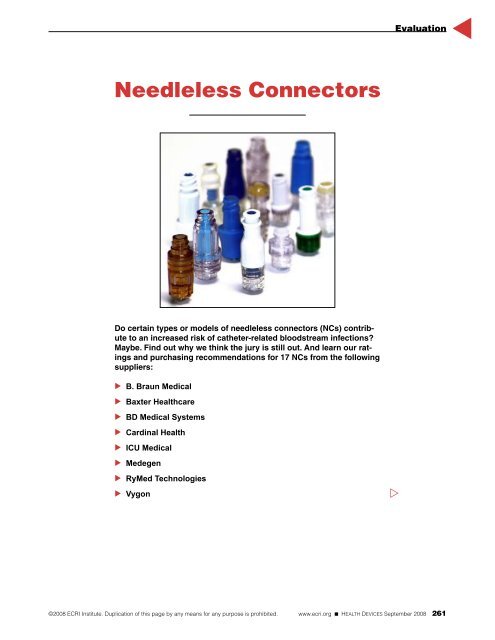
Needleless Connectors Iv Therapy
However their use has led to an increase in the incidence of complications such as.
History of needleless connectors. The design of intravenous IV needleless connectors NCs plays a substantial role in HA-BSI risk. Needleless connector design features were developed in the 1990s to reduce the risk of needlestick injuries in healthcare workers. The ancient Greeks and Romans knew injection as a method of medicinal delivery from observations of snakebites and poisoned weapons.
Flow rates for undiluted RBC units were 53 slower than crystalloid solution 220 mLmin vs. While needleless connectors were initially developed to help improve healthcare professional safety in recent years the use of needleless connectors may have contributed to improved patient care as well. Needleless connectors including the standard split septum and the luer-activated mechanical valve connectors have been introduced into clinical practice to eliminate the risk of needlestick injuries by avoiding the use of needles when accessing the intravascular catheters.
Our award-winning needle-free valves help enhance clinician and patient safety by helping to prevent needle-stick injuries. There are also references to anointing and inunction in the Old Testament as well as the works of Homer but injection as a legitimate medical tool was not truly explored until the 17th century. Needleless connectors have been introduced into clinical practice to eliminate needlestick injuries and prevent catheter-related bloodstream infections.
Needleless connector disinfection isnt a new concept but it has received little focused attention. The addition of the MaxPlus needleless connector. Frequent product training on needleless connectors the specific type in use and correct techniques are necessary.
The second is to start using safe working practices such as the hands-free technique. History of Needleless Connector Design Needles to Current Generations of Connector Design The split-septum interlink is the oldest and most studied connector providing the gold standard in clinical outcomes in studies up until about 2007. The requirements for marketing have changed over time.
Additionally the effect of the MaxPlus clear needleless connector CareFusion San Diego CA was measured in all three infusion groups. In the past two decades connectors have evolved in a direction that has inadvertently increased the risk for. Needleless connectors NCs were introduced in the 1990s to reduce the risk of health care worker needlestick injuries.
Currently the number of. Guidelines The Food and Drug Administration FDA has regulatory authority over the marketing of needleless connectors. N eedleless connectors were first introduced about 20 years.
Needleless connectors NCs are essential devices which connect to the end of vascular catheters and enable catheter access for infusion and aspiration. Our technology helps standardise Y-site access for administration gravity secondary and extension sets to help reinforce best aseptic and other practices. Within the past 20 years there has been an explosion of devices designed to allow connection of multiple intravenous sets and catheter hubs without the use of needles.
Needleless connectors containing silver may signifi - cantly reduce both microorganisms and downstream biofilm the slimy substance that protects and sur - rounds organisms although prospective random - ized clinical trials are needed to determine the impact of this reduction on CRBSI. The most important tool in preventing central lineassociated bloodstream infection CLABSI still remains the individual clinician at the point of care so education has been. This is the procedure for changing the needleless connector cap on peripheral and central venous catheter CVC.
The third line of prevention is increased personal protective equipment such as. There are various different designs which make it difficult for purchasers to identify the features which present the least risk and greatest safety. Although needleless connectors serve that purpose their use has been associated with an increase in such complications as catheter-related.
How it is disinfected pre access determines if and. History Early use and experimentation. First needleless connector 2015 The original features of the first needleless connector include 1 a solid sealed access surface 2 a simple fluid filled internal design and 3 a visible fluid path.
Negative and positive displacement mechanical valves have been associated with increased rates of catheter-related bloodstream infections as compared with split sept. These devices also known as end caps luer-activated devices injection caps or mechanical valves serve their intended purpose well. In 2005 the FDA recognized that there is a microbial risk with needleless connectors.
The split-septum device is. Needleless devices for connecting IV catheters administration sets and syringes were introduced in the early 1990s for the purpose of reducing the risk of needlestick injuries among health care providers. Policy Statements The needleless connector is changed.
The 2011 CDC guidelines state that this split septum design may be preferred over some mechanical valves. The NC is the microbial gatekeeper for vascular catheters. The SmartSite needle-free valve also partners with the Texium.
These devices are used to connect catheters administration sets andor syringes to deliver IV therapy.

China Luer Lock Needle Free Connector Iv Infusion Needleless Connector China Iv Needle Needleless Connector

China Positive Pressure Needle Free Connector Needleless China Infusion Connector For Injection Positive Pressure Needle
Https Higherlogicdownload S3 Amazonaws Com Apic D01c8ebe 148f 4b16 Bdac Fa55017eb594 Uploadedimages Jan 2014 Nadine Nakazawa Rn Pdf

Global Needleless Iv Connector Market Size Study And Regional Forecast Marketing Connector Global
